What Is a Modular Helmet? A Complete Guide to Features, Safety, and Fit
Last Updated On: July 26, 2026
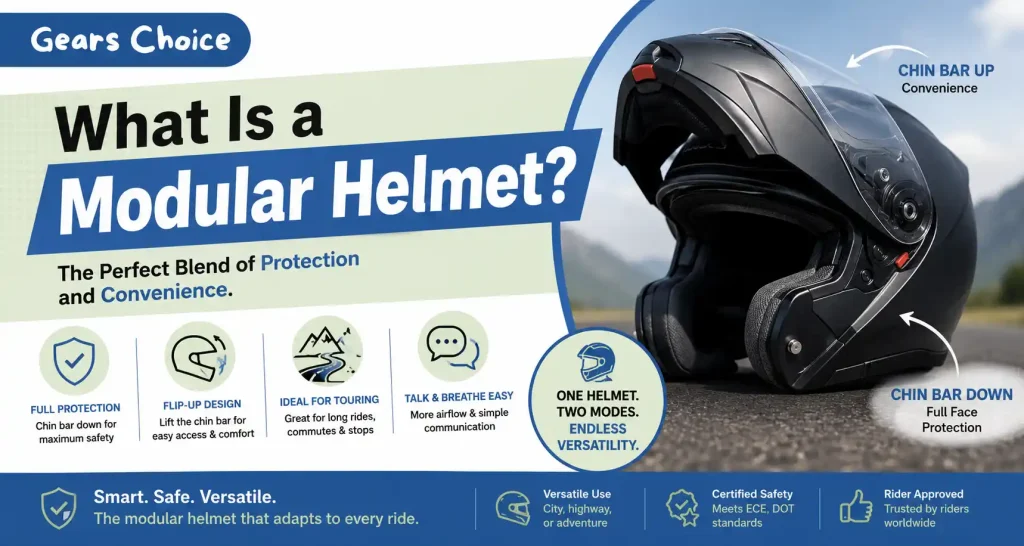
If you have spent any time browsing helmets online, you have probably landed on a listing that looks like a full face helmet but has a hinge running along the sides. That hinge is the whole story. A modular helmet is a motorcycle helmet with a chin bar that lifts up and out of the way instead of staying fixed in place, giving you a full face helmet when it is down and something closer to an open face helmet when it is up.
People often ask what is a modular helmet motorcycle riders keep recommending for touring and commuting, and the short answer is that it is the helmet built for riders who do not want to choose between protection and convenience. You get to keep the chin bar for real crash protection, then flip it open at a gas station, a red light, or a rest stop without pulling the whole helmet off your head.
At Gears Choice, we spend a lot of time comparing helmet styles so riders can pick gear that actually fits how they ride, not just how a helmet looks in a product photo. This guide walks through construction, certification, real advantages and drawbacks, and how a modular helmet stacks up against the alternatives.
How a Modular Helmet Is Built
Every modular helmet starts with the same basic shell materials used in standard full face helmets: polycarbonate, fiberglass composite, or carbon fiber, depending on price point. What sets it apart is the hinge mechanism mounted low on each side of the shell. Press a release button near your chin and the entire chin bar, along with the attached visor in many designs, rotates up and locks flat against the top of the shell.
A few construction details matter more than most riders realize:
- The hinge and locking pins. A quality modular helmet locks solidly in both the open and closed position. You should feel a firm click, not a loose wobble, when you close the chin bar back down.
- Reinforced shell sides. Because the shell is interrupted by a mechanical joint, manufacturers add extra material around the hinge points to keep the structure rigid.
- Interior padding shaped around the hinge. The cheek pads and liner are cut slightly differently than a standard full face helmet to make room for the mechanism, which is part of why fit can feel a little different between the two styles.
- A drop down internal sun visor. Most modular models include this feature, something you rarely see built into a standard full face helmet.
This hinged design is also exactly why some riders search for what is a modular full face helmet in the first place. It is not a separate category invented from scratch. A modular helmet is essentially a full face helmet with a movable chin bar bolted on, which is why it inherits most of the same shell technology and most of the same testing requirements.
Is Modular Helmet Safe to Wear?
Yes, a certified modular helmet is safe for everyday road riding, though there is one detail worth understanding before you buy. The hinge is, by design, a weak point compared to a single piece shell. A full face helmet with no moving parts distributes impact force evenly across the whole structure. A modular helmet has to manage that same force while working around a mechanical joint, so manufacturers add reinforcement specifically to compensate.
According to the National Highway Traffic Safety Administration, modular motorcycle helmets are recognized as their own helmet category precisely because they combine full face coverage with the airflow and convenience of an open design, and the agency notes they are especially popular with adventure and dual sport riders. The bigger safety factor, according to the Centers for Disease Control and Prevention, is simply wearing a helmet at all: helmets remain the single most effective piece of gear for reducing motorcycle head injuries, and states with universal helmet laws consistently see far fewer fatal head injuries than states without them.
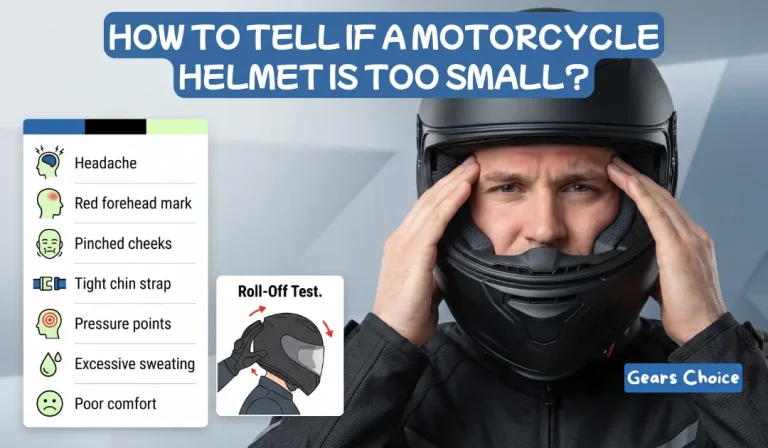
Fit matters just as much as certification. A helmet that is the wrong size will not protect you the way it is rated to, no matter how good the shell is. If you are unsure how snug a helmet should sit, our guide on how a motorcycle helmet should fit walks through the pressure test most shops use before you ride away in a new lid.
Certifications Worth Checking Before You Buy
Certification is where a lot of riders get tripped up, especially with modular helmets, because there is an extra layer that does not apply to standard full face or open face designs.
- DOT (FMVSS 218). This is the baseline legal requirement for helmets sold in the United States. Every helmet on a store shelf should carry this label.
- ECE 22.06. This is the international standard recognized in more than fifty countries and administered under United Nations Regulation No. 22, which the UNECE describes as the global blueprint helmet manufacturers and regulators have used for decades to certify protective headgear.
- Snell certification. This is a voluntary, non government standard that goes beyond the legal minimum. The Snell Memorial Foundation tests helmets to a higher impact threshold than DOT requires, and a Snell sticker alongside a DOT sticker is generally a strong signal of build quality.
- P and J homologation. This is the one that is specific to modular helmets. Under ECE 22.06, a helmet is tested and labeled as J if it has no chin bar, P if it has a protective chin bar, or P over J if it passes impact testing in both the closed and open positions. Only a helmet carrying that P over J rating has actually been proven safe to ride with the chin bar flipped up. As one long time helmet industry consultant explains in a detailed breakdown of global helmet standards, a modular helmet without that rating is only certified for closed position use, even though the hinge lets you physically open it.
That last point is worth repeating because it surprises a lot of buyers: just because a modular helmet can flip open does not automatically mean it is legal or tested to be ridden that way. Always check the label before assuming.
Modular vs Full Face Helmet: Which One Should You Choose
This is the comparison every rider eventually runs into, and the honest answer depends on what you actually do on the bike. A full face helmet gives you the most protection per dollar because the shell has no joints to engineer around. It is generally lighter, quieter at highway speed, and cheaper than a comparable modular model.
The tradeoff is that you cannot get any airflow without taking the whole thing off, and putting one on over glasses can be an awkward wrestling match. If you want to see what a dedicated full face design looks like, our list of the best full face helmets breaks down the top options by riding style.
A modular helmet trades a small amount of weight and a slightly higher price for real world flexibility. You can talk to a passenger, grab a drink, or cool off at a stop without removing the helmet, and many riders who wear glasses find modular designs far easier to put on and take off.
An open face helmet sits at the opposite end from a full face helmet, offering the most airflow and the least protection since there is no chin bar at all.
If your riding is mostly short trips around town, a full face or open face helmet may serve you fine. If you tour, commute long distances, or frequently stop and start throughout a ride, the modular format tends to be the better fit. For a side by side look at how open designs compare on ventilation and protection, our full face versus open face helmet guide covers the tradeoffs in more depth.
Real Advantages and Drawbacks
What you gain:
- Full face protection when the chin bar is locked down, with open face convenience whenever you need it
- Easier on and off for riders who wear glasses
- A built in sun visor on most models, cutting down on squinting or juggling sunglasses
- The ability to talk, drink, or catch some air at a stop without pulling the helmet off
What you give up:
- Extra weight compared to an equivalent full face helmet, which can add up on long rides
- Slightly more wind noise around the hinge seams at highway speed
- A higher price tag for a quality hinge and dual position lock
- A chin bar that is engineered to be strong, but is still a mechanical joint rather than a single molded piece
Modular Helmets Across Different Types of Riding
Modular design is not limited to street motorcycles. Riders asking what is a modular snowmobile helmet are usually looking for the same flip up convenience adapted for cold weather use, where being able to clear a fogged shield or talk to a riding partner without removing thick winter gear is a real practical advantage. Our roundup of the best snowmobile helmets includes several modular options built with insulated liners and dual pane shields for that exact reason.
The format shows up on pedal bikes too. Someone searching what is a modular bike helmet is typically describing a bicycle helmet with a similar flip up chin guard, aimed at commuters who want facial protection during the ride but do not want to wear a full face design the rest of the time. It is a smaller niche than motorcycle modular helmets, but the underlying idea, protection when you need it and openness when you do not, carries over directly.
If you want a broader overview of how modular helmets compare to every other style on the market, our guide to types of motorcycle helmets covers the full lineup side by side, from half helmets to dual sport designs.
Final Thoughts
A modular helmet is not a compromise so much as a different set of priorities. You get certified full face protection when you need it most and open face convenience whenever the ride calls for it.
The details that matter before you buy are the same ones that trip most riders up: confirm the certification, check whether it carries P over J homologation if you plan to ride with the chin bar open, and try it on for at least a few minutes to check the fit around your jaw and cheeks. Browse the full range of helmets and riding gear at Gears Choice to compare modular options against every other style before you commit.
Frequently Asked Questions
Can you legally ride with a modular helmet chin bar open?
Only if the helmet carries P over J homologation under ECE 22.06. Without that rating, the helmet has only been tested and certified in the closed position.
Are modular helmets heavier than full face helmets?
Yes, generally. The hinge mechanism and the reinforced shell around it typically add a noticeable amount of weight compared to a similarly built full face helmet.
Do modular helmets work well for riders who wear glasses?
Very well. Flipping the chin bar open before putting on or removing the helmet avoids the awkward struggle that a fixed full face design can create for eyeglass wearers.
Is a modular helmet a good choice for a first helmet?
It can be, especially for new riders who value the flexibility of switching between full face and open face use. Just confirm the fit is correct and check for a DOT or ECE label before buying.

Hi, I’m James Dean. My motorbike obsession started at age seven with a 50cc bike, and I’ve been riding ever since. From motocross in my teens to cruising and snowmobiling today, I’ve got over 15 years of experience. As a mechanical engineer and passionate rider, I founded gearschoice.com to share my insights and help you find the best motorcycle gear.