What Is a MIPS Bike Helmet? How It Works and Is It Worth It
Last Updated On: Aug 01, 2026
If you’ve spent more than five minutes shopping for a new bike helmet, you’ve probably run into a little yellow dot printed somewhere inside the shell, along with a sticker that says MIPS. Some helmets have it. Some don’t. And the ones that do usually cost a bit more. So what is a MIPS helmet, exactly, and does it actually make you safer, or is it just clever marketing that helmet brands use to justify a higher price tag?
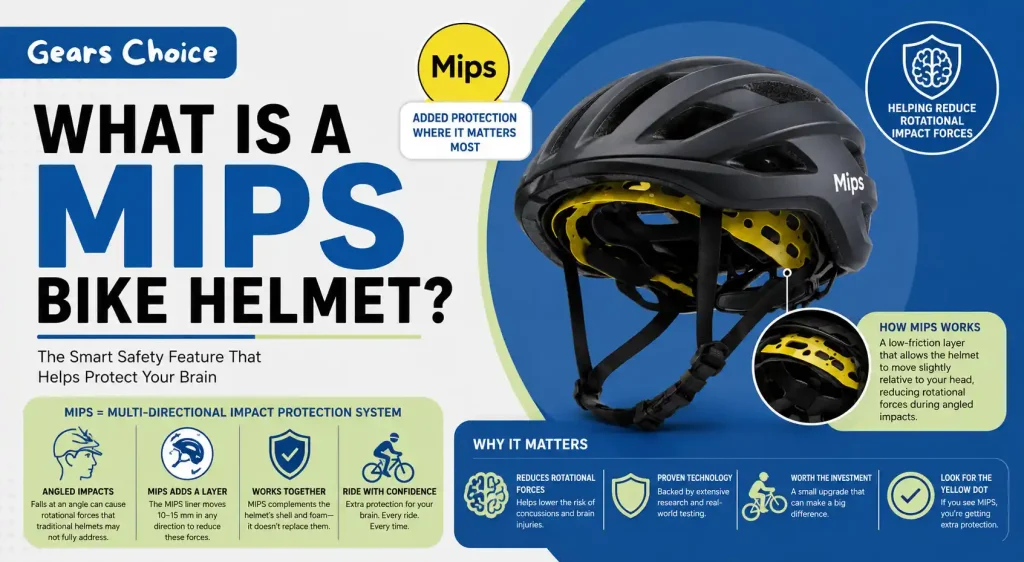
Here’s the short answer: MIPS is a safety feature built into a helmet’s interior that helps reduce the rotational force your brain experiences during an angled crash. It doesn’t replace the padding and shell that absorb a straight on hit. It works alongside them, targeting a type of impact that traditional helmet design has largely ignored for decades. Let’s break down exactly what that means, how it works, and whether it’s worth the extra money.
What Does MIPS Stand For?
MIPS stands for Multidirectional Impact Protection System. It’s also the name of the Swedish company that invented and patented the technology. The company was founded by a neurosurgeon and a biomechanics researcher who spent years studying why helmets that passed every official safety test still failed to prevent certain brain injuries.
Their answer was rotational motion, the twisting force your brain experiences when your head hits the ground at an angle instead of straight on. That research eventually became the MIPS meaning most riders now associate with the little yellow logo, and it’s the reason the system exists at all.
What Is MIPS Helmet Technology and How Does It Work?
Picture your helmet built in two layers instead of one. The outer layer is the familiar hard shell and foam that every certified helmet already has, and it’s designed to absorb the force of a direct, straight line impact. Sitting just underneath that, MIPS adds a thin, low friction liner that isn’t rigidly locked to the rest of the helmet.
When you crash at an angle, which is how most real bike accidents actually happen, that liner allows the helmet to rotate slightly, somewhere between 10 and 15 millimeters, relative to your head. That small amount of slip redirects rotational energy away from your brain instead of transferring all of it directly through the skull. According to MIPS’s own technical explanation, this movement is designed to mimic the natural slip plane found in the layers of tissue surrounding the human brain.
It’s a simple idea mechanically, but it targets a problem that most helmet certifications, including the mandatory federal standard enforced by the Consumer Product Safety Commission, were never built to measure in the first place. CPSC certification confirms a helmet can handle a direct vertical impact. It says nothing about rotational forces from an oblique hit, which is exactly the gap MIPS was created to fill.
Are There Different Types of MIPS?
Most riders picture a single yellow plastic liner when they think of MIPS, and for a long time that was accurate. That original design, often called the standard MIPS liner, is still the most common version and is what you’ll find in the majority of budget and midrange helmets. Newer variations have since appeared.
Some higher end helmets use an integrated MIPS system built directly into the helmet’s padding rather than as a separate visible layer, which keeps the fit and ventilation closer to a non MIPS helmet. Others use a spherical design, where the inner and outer foam layers rotate against each other like a ball and socket joint instead of relying on a plastic liner at all. The engineering looks different in each case, but the goal is identical: let the helmet twist slightly on impact so your head doesn’t have to.
MIPS vs Non MIPS: What’s Actually Different?
From the outside, a helmet with MIPS and one without it usually look identical. Same shell shape, same vents, same style options. The difference lives inside, and it comes down to three practical things. Weight is barely affected. A MIPS liner typically adds well under an ounce, something most riders never notice once the helmet is on.
Fit can shift slightly, since the liner takes up a small amount of internal volume, so it’s worth trying a helmet on in person rather than assuming your usual size will feel the same. And price is the most noticeable gap. MIPS equipped helmets generally run somewhere between twenty and sixty dollars more than the identical model without it, though that premium has shrunk considerably as more brands have adopted the technology across their entire lineup.
Functionally, a non MIPS helmet still meets every mandatory safety standard and will protect you in a straight on impact just as well. What it doesn’t offer is that extra layer of rotational protection for angled falls, which independent testing suggests make up a large share of real world cycling accidents.
Does MIPS Actually Make a Helmet Safer?
This is where honesty matters more than marketing. No helmet company, MIPS included, claims their system eliminates the risk of concussion or brain injury. MIPS itself states plainly that its system cannot guarantee protection in any specific accident, only that it’s designed to reduce a known risk factor.
That said, the independent evidence is fairly encouraging. A peer reviewed comparison of several rotation damping helmet systems, published through the National Center for Biotechnology Information, found that two of the four technologies tested significantly reduced rotational head acceleration and estimated brain strain compared to a standard helmet with no rotational system at all. The results varied by design, which is worth noting, since not every rotation damping system performs identically.
The Virginia Tech Helmet Lab takes a similar evidence based approach, running helmets through repeated impact tests that measure both linear and rotational forces, then assigning a star rating based on estimated concussion risk. Their ratings consistently show that helmets with rotation management systems, MIPS among them, tend to score better than comparable helmets without one, though the specific model matters just as much as the technology inside it.
For an older, more traditional benchmark, the Snell Memorial Foundation has spent decades developing independent helmet standards that go beyond the legal minimum, and its certification remains a useful reference point when comparing helmet quality across brands. Put simply, the science supports the concept. It just doesn’t support treating any single helmet, MIPS or otherwise, as invincible.
Is a MIPS Helmet Worth It?
This is the question most people actually want answered, and it depends less on the technology and more on how and where you ride.
If you commute in traffic, ride a road bike at speed, mountain bike on technical trails, or you’re buying a helmet for a child who’s still learning to balance, the modest price premium for MIPS is easy to justify. These are exactly the riding situations where an angled fall is common, and the added protection targets that scenario directly.
If you’re an occasional rider who sticks to flat paved trails at a relaxed pace, a well fitted, properly certified helmet without MIPS will still do its job. In that case, the extra few dollars might be better spent on a helmet with a more comfortable fit or better ventilation, since a helmet you actually enjoy wearing is one you’re more likely to put on every single time.
Is MIPS Worth It If I Only Ride Casually?
For casual, low speed riding, the honest answer is that MIPS is a nice extra rather than a strict necessity. Fit and proper wear matter more than any single feature. A loose, poorly adjusted helmet, MIPS equipped or not, will protect you far less than a snug one without it. If you’re not confident your current helmet fits correctly, it’s worth reading through how to wear a bike helmet properly before worrying about which internal technology it uses.
How to Tell if a Helmet Has MIPS
Checking is easier than it sounds. Look for a small yellow dot or yellow trim, usually near the back of the helmet’s interior padding. Most manufacturers also print MIPS clearly on the box and product page, since it’s a feature they want you to notice. If you’re shopping online and the listing doesn’t mention it either way, that’s usually a sign the helmet doesn’t include it, since brands rarely leave a selling point like this unmentioned.
It’s also worth remembering that any bike helmet sold in the United States, MIPS or not, is required by law to meet a baseline safety standard. Riding without any helmet at all carries its own legal and safety implications depending on where you live, which is covered in more detail in this guide on whether it’s illegal to ride a bike without a helmet.
Choosing the Right MIPS Bike Helmet
Once you’ve decided MIPS makes sense for your riding, the next step is picking a helmet that fits your specific use case. Road riders covering long distances tend to prioritize ventilation and low weight, which is where a helmet like the Giro Agilis MIPS tends to stand out. Commuters who want a more casual, everyday look often gravitate toward something like the Giro Register MIPS, which trades some of the road racing styling for a more relaxed fit.
And riders looking for a solid entry point into MIPS protection without paying a premium price often land on something like the Giro Isode MIPS. Whichever direction you go, the technology inside the helmet is only half the equation. The other half is making sure it actually fits your head correctly, since even the best rotational protection system can’t do its job in a helmet that sits loosely or at the wrong angle.
The Bottom Line
MIPS helmets have moved from a premium niche feature to something close to an industry standard in just over a decade, and the underlying science behind rotational protection holds up reasonably well under independent scrutiny. It won’t turn any helmet into an injury proof shield, and it isn’t the only thing that matters when choosing gear.
But for the price most brands now charge, it’s a sensible addition for the vast majority of riders, especially anyone riding in traffic, on trails, or at speed. If you’re still comparing options, browsing the full range of helmets on Gears Choice is a good next step to see how MIPS and non MIPS models stack up across different riding styles and budgets.
Frequently Asked Questions
What is the MIPS helmet meaning in one sentence?
It’s a low friction liner inside a helmet that lets the shell rotate slightly during an angled impact, redirecting rotational force away from the brain.
Do all MIPS equipped models look the same inside?
No. Some use a visible yellow plastic liner, others integrate the slip layer directly into the padding, and a few use a spherical design with no separate liner at all.
How much more does a MIPS equipped model typically cost?
Usually somewhere between twenty and sixty dollars more than the identical non MIPS version, though the gap continues to shrink as adoption grows across the industry.
Is MIPS required by any safety standard?
No. It’s an added feature on top of mandatory certification, not a legal requirement. A helmet without MIPS can still be fully certified and legal to sell and use.
Can I add MIPS to a helmet I already own?
No. It has to be built into the helmet during manufacturing, so it isn’t something you can retrofit into an existing helmet afterward.

Hi, I’m James Dean. My motorbike obsession started at age seven with a 50cc bike, and I’ve been riding ever since. From motocross in my teens to cruising and snowmobiling today, I’ve got over 15 years of experience. As a mechanical engineer and passionate rider, I founded gearschoice.com to share my insights and help you find the best motorcycle gear.